
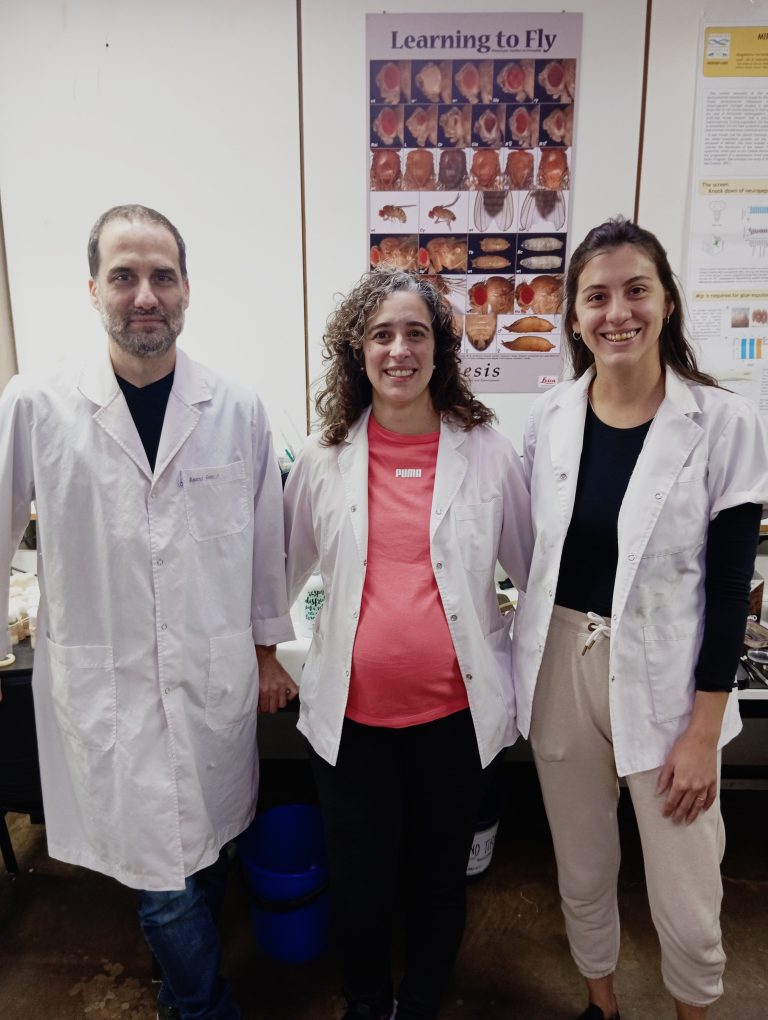
LABORATORY OF DEVELOPMENTAL PHYSIOLOGY AND GENETICS
Principal Investigator
- Dr. Andrés Garelli

Research lines
At the Laboratory of Developmental Physiology and Genetics, we study the molecular mechanisms underlying the neuroendocrine circuits that control aspects of development and behavior using Drosophila melanogaster as a model system. Our research focuses on a signaling pathway involving Dilp8, a hormone belonging to the insulin-like peptide family, and its receptor Lgr3, a G protein-coupled receptor (GPCR).
Our current research encompasses two main lines of investigation:
- Hormonal modulation of neuronal circuits: A sharp increase in Dilp8 production occurs in the epidermis of the Drosophila larva as it transitions to the pupal stage. Dilp8 acts on a population of neurons expressing the LGR3 receptor and induces a series of stereotyped behaviors required for puparium formation. This research line focuses on the mechanisms by which Dilp8 modulates the activity of the motor circuits underlying this behavior. Ultimately, we aim to understand how a neuronal network can generate distinct motor patterns in response to hormonal signals that modulate its activity.
- Role of Dilp8 in oogenesis and reproduction: Dilp8 is also expressed in the follicle cells surrounding mature oocytes. This research line focuses on elucidating how Dilp8 modulates reproductive function.
Researchers / Fellows
- Dr. Yanel Volonté
- María Sol Pérez, BSc
Collaborators
- Alisson Gontijo (FCUL, Portugal)
- Cesar Mendes, (CEDOC, Portugal)
Selected publications
Garelli, A., Gontijo, A. M., Miguela, V., Caparros, E., & Dominguez, M. (2012). Imaginal discs secrete insulin-like peptide 8 to mediate plasticity of growth and maturation. Science, 336(6081), 579–582.
Garelli, A., Heredia, F., Casimiro, A. P., Macedo, A., Nunes, C., Garcez, M., Dias, A. R. M., Volonte, Y. A., Uhlmann, T., Caparros, E., Koyama, T., & Gontijo, A. M. (2015). Dilp8 requires the neuronal relaxin receptor Lgr3 to couple growth to developmental timing. Nature communications, 6, 8732
- Heredia, F., Volonté, Y., Pereirinha, J., Fernandez-Acosta, M., Casimiro, A. P., Belém, C. G., Viegas, F., Tanaka, K., Menezes, J., Arana, M., Cardoso, G. A., Macedo, A., Kotowicz, M., Prado Spalm, F. H., Dibo, M. J., Monfardini, R. D., Torres, T. T., Mendes, C. S., Garelli, A., & Gontijo, A. M. (2021). The steroid-hormone ecdysone coordinates parallel pupariation neuromotor and morphogenetic subprograms via epidermis-to-neuron Dilp8-Lgr3 signal induction. Nature communications, 12(1), 3328.
- Fernandez-Acosta, M., Zanini, R., Heredia, F., A Volonté, Y., Menezes, J., Prüger, K., Ibarra, J., Arana, M., Pérez, M. S., Veenstra, J. A., Wegener, C., Gontijo, A. M., & Garelli, A. (2025). Triggering and modulation of a complex behavior by a single peptidergic command neuron in Drosophila. PNAS, 122(11), e2420452122.
- Volonté, Y., Heredia, F., Zanini, R., Menezes, J., Perez, M. S., Gualdino, M., Lage, L., da Silva Luz, L., Casimiro, A. P., Homem, C. C. F., Vasconcelos, M. L., Garelli, A., & Gontijo, A. M. (2026). Dilp8 relaxin signaling from ovarian follicle cells to Lgr3-positive neurons promotes spontaneous ovulation and oocyte quality in Drosophila. Development, 153(5), dev204955.
Contact:
DR. ANDRÉS GARELLI
agarelli@criba.edu.ar
+ 54 291 4037195